














AI vs Humans: Who Will Survive the Future of Work?
Artificial Intelligence (AI) is transforming the global job market at a rapid pace, and this has created both excitement and fear among employees, organizations, and governments. Although some media outlets have reported that “9 crore jobs” could be lost, the truth is that AI is likely to change more jobs than it will destroy.
Understanding the AI Shift | AI future of work
Artificial Intelligence: This pertains to computer systems that have the ability to perform tasks that require human intelligence, including analyzing data, pattern recognition, content generation, and making predictions. Right from customer service chatbots to financial fraud detection software and medical diagnosis assistance software, AI is already at work.
According to various industry reports, automation is expected to have a major impact on repetitive tasks. But at the same time, the creation of new jobs, especially in the technology sector, has been emphasized.

Industry-Wide Impact
The effects of AI are being felt across major sectors:
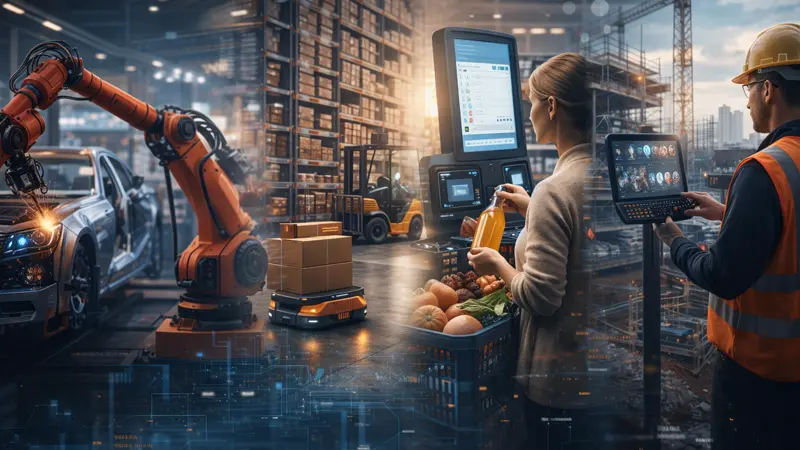
- Construction: Cost estimation, site monitoring, and safety risk prediction are being enhanced by AI technology. Engineers are increasingly moving towards planning and management work.
- Manufacturing: Quality inspection and maintenance are being done by robots and computer vision. There is a decrease in manual quality inspection jobs, but technical skills are in higher demand.
- Retail: Smart inventory management, demand forecasting, and self-checkout technology are changing store work, and there is a decrease in cashier-intensive staffing.
- Logistics: Route optimization, warehouse automation, and predictive delivery systems are changing the nature of staffing, and there is an increase in the demand for planners and technology experts.
Call Centers Face Rapid Transformation
Customer service is one of the areas that is changing at a rapid pace. Chatbots powered by AI are now capable of handling a high volume of common customer inquiries, supporting multiple languages, and basic troubleshooting.
Customer service representatives are still required for complex issues, emotional conversations, and sales. Analysts forecast a reduced need for entry-level customer service representatives but an increased need for experienced customer service representatives with the ability to address complex customer needs.
Is Coding Under Threat? AI future of work
Contrary to concerns, however, experts affirm that software development is not becoming extinct. Rather, AI is only accelerating productivity with the help of basic code generation. Software developers are now focusing on higher-level tasks such as system design, architecture, and problem-solving.
World Economic Forum — Future of Jobs Report
This trend is also giving rise to the need for professionals who can work well with AI-enabled tools.
Professional Roles Are Evolving
AI is influencing nearly every knowledge profession:
- Engineers: Less manual drafting, more system design.
- Accountants: Automation of data entry, growth in advisory roles.
- Doctors: AI assisting diagnostics rather than replacing clinicians.
- Architects: Faster concept design and visualization.
- Creative professionals: AI increases speed, but originality and storytelling remain human-driven.
Automation vs Human Skills
AI excels at scale, repetition, and pattern recognition. Humans retain advantages in judgment, creativity, communication, trust, and strategic thinking. Experts increasingly describe the future workforce as a collaboration between humans and AI rather than a replacement scenario.
Government Adoption Expands
Public sector adoption of AI is also accelerating. Governments are using AI for fraud detection, traffic management, public service automation, and policy analysis — creating new demand for digital and data-focused roles.
Google AI — Research and tools
Most Vulnerable Roles
Jobs most exposed to automation include:
- Data entry and clerical work
- Basic customer support
- Cashier roles
- Routine manufacturing tasks
- Basic bookkeeping
- Entry-level repetitive content production
More Resilient Career Areas
Roles considered relatively resilient include:
- Healthcare and caregiving
- Skilled trades
- Technology-hybrid roles
- Management and strategy
- Research and education
- High-level creative work
The Bigger Picture | AI future of work
As economists point out, technological disruption in the past has replaced tasks, not jobs. AI is predicted to boost productivity, drive the need for skills, and further accentuate the divide between high-skill and low-skill jobs.
The overriding message from experts in the sector is that adaptability will be the key to job security. Those individuals who are constantly updating their skills, especially in digital literacy, problem-solving, and working with AI, are likely to be the biggest beneficiaries of this change.
In the new world of work that is emerging, the choice may not be between AI and humans, but between humans who know how to work with AI and those who don’t.











[…] AI future of work | AI vs Humans: Future of Work ExplainedApple iPhone 17 Pro Launch Date, Price in India & Big Upgrades RevealedPrice of Vivo V70 in India: Expected Cost & SpecsGalgotias University: Hidden Challenges Behind the Growing Reputation?Apple iPhone 18 Pro Max: Expected Features, Design Changes, AI Upgrades and Launch TimelineAllmobile […]